
Five ways AI impacts geopolitical risk in Latin America
For the record, I did ask various AI models to try to write this post to see what they came up with. They made interesting points, but I still think my human written version is significantly better.
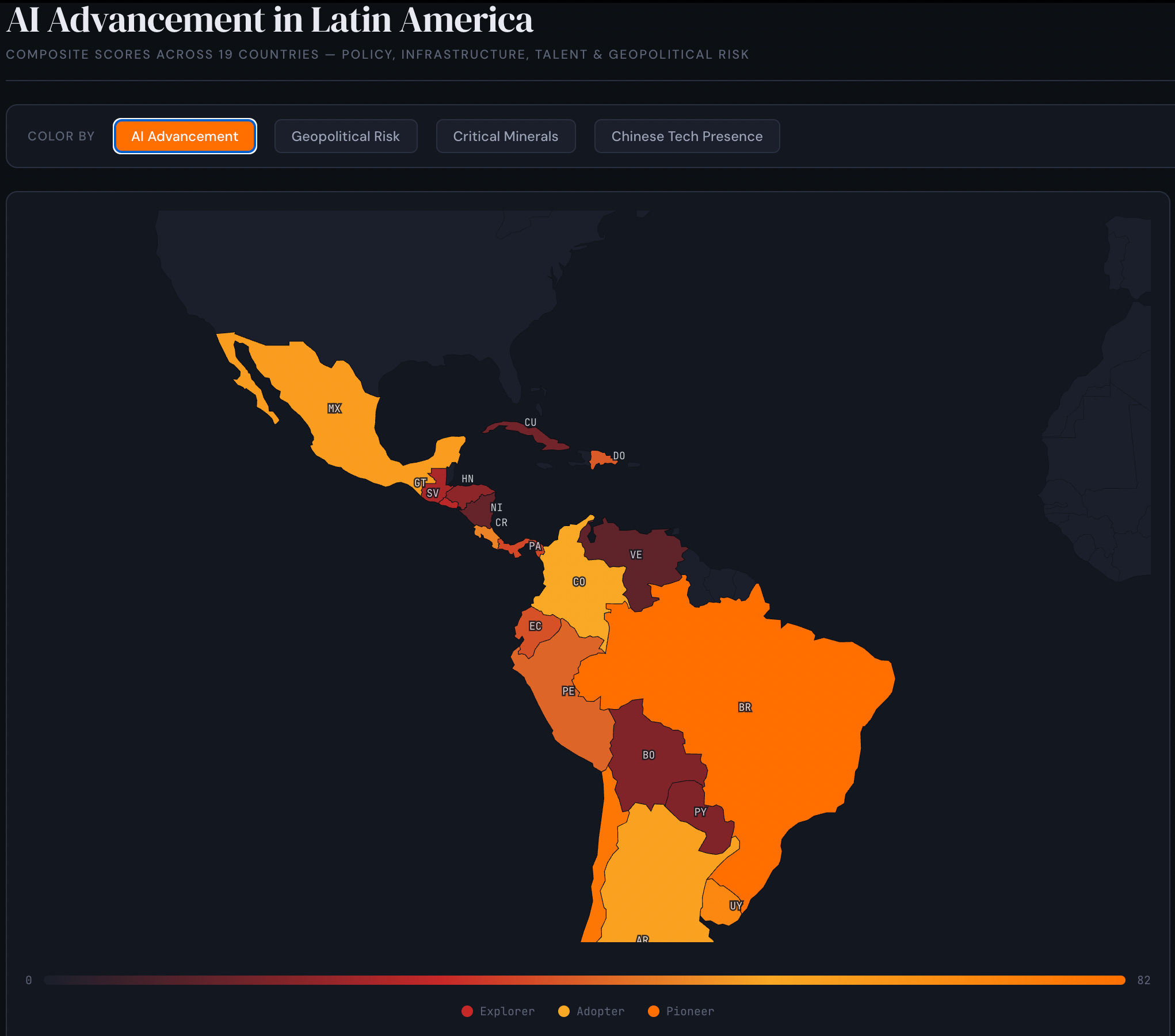
In the past year, I’ve regularly received the question of how AI will impact Latin American politics. Here are five points that I regularly make when answering that question.
A middle class job disruption. The AI boom is coming for Latin America’s middle class jobs. Paralegals, accountants, call center workers, and coders are all facing potential job losses in the coming years due to better AI systems. US and European companies that were outsourcing service center work to Latin America are going to find it cheaper and more efficient to outsource it to AI. This type of job loss disrupts the entire model for Latin American development. For decades, governments (and development consultants) have told people to go to high school and university so they can get white collar jobs and move their families and the whole country up the economic value chain. When those jobs are hit, it will impact political stability, tax bases, and migration patterns. Youth unemployment is already a regional challenge and the demographics of the AI job losses will exacerbate it.
The new extractive dependence. The world’s biggest AI companies need data centers that require land, energy, and water. Latin America has that. The investments could spark an economic boom for the region. And yet, if companies come to Latin America to build data centers that primarily benefit foreign companies and users, it’s just a new variation on the same economic trap the region has faced for hundreds of years. The region will provide the primary inputs but not move up the economic value chain in terms of intellectual property, high paying jobs, or profits that can be taxed and used to provide social services. The data centers also create secondary costs (water usage, environmental damage, noise) that the local citizens will pay.
Navigating the AI great game. Beyond the question of natural resources and data centers, the US and China are competing to control the most popular base models for AI. Latin America’s efforts to build a regional AI model are a great experiment that should be expanded, but the region will still be pulled into the fight between the two big superpowers and their models. Countries and regions are demanding different regulations on the private sector actors involved, with Europe being the most strict. Latin American countries need to adopt regulatory frameworks and those laws will interact with however the US, EU and China regulate their companies. Despite what I wrote above about data centers, every country is considering some form of data sovereignty that won’t allow their citizens’ personal data to be stored or manipulated outside of the country. China will attempt to lock in some of its gains in Latin America via contracts and hardware including smart cities. In the past, the US would have relied more on private-sector dominance and standards-setting, but Trump and any future US president may view China’s push on AI as a threat and be more aggressive in demanding Latin America choose which path to follow.
Critical minerals as a leverage point. The old extractive question also continues under AI development. Latin America has numerous critical minerals and energy assets essential to the hardware behind the AI buildout. The presence of these minerals makes the US and China view the region as key territory in the great game, but Latin America also gets a say. Latin America’s mineral and energy wealth provides leverage in their negotiations with the bigger powers. They can and should demand technology transfer, local processing, or infrastructure commitments in exchange for access.
The tech-enabled Mano Dura. We already see technology such as facial recognition, financial analysis, and crime pattern analysis reaching the region. Every government will want to use the new technology to improve security. While some will do so with cautious oversight and others will quietly break the norms, the Bukele imitators will loudly embrace the dystopian elements of surveillance and other anti-gang technologies as an enormous political asset. Dictatorships will gain new tools more quickly than democracy activists can use them to undermine the autocrats. China will aim to take advantage of this political moment by offering effective technology in this space at cheap prices.
Those are just five trends I regularly discuss, but there are certainly many other impacts, and not all are negative. The technology could provide a leap-frogging capability for one or several countries to change their entire economic model. The tech can also enable citizens and cities to organize in new ways. I’m hopeful about how AI will benefit the future, but concerned about the disruptive interlude while we all adapt to the new tech and deal with the initial economic fallout which is likely to be more negative. Latin American politicians, civil society, businesses, and education systems need to consider these issues and take action, or they risk the world acting first and shaping how the technology will impact the region.