

Imagine four people (or prediction markets) predicting Brazil’s elections.
Person A: Lula is 80% likely to win
Person B: Lula is 51% likely to win
Person C: Flavio is 51% likely to win
Person D: Flavio is 80% likely to win
Right now, five days from the first round, B and C are closest to correct, while A and D are wrong in the sense that they are overconfident.
Once the election is decided (likely after a second round), from a punditry standpoint, either [A and B] or [C and D] will be declared “correct,” and the other two will be declared “wrong.”
If you had a coin weighted 60% heads, it would take about 200 flips to be certain it wasn't a fair coin. If you had a 51-49 coin, it would take over 20,000 flips to know. With an election, you only get one coin toss. Mathematically, we will never know whether predictor B or C was truly “correct.” But one of them will be called right and the other wrong.
It’s unfortunate, but that is how the game is played.

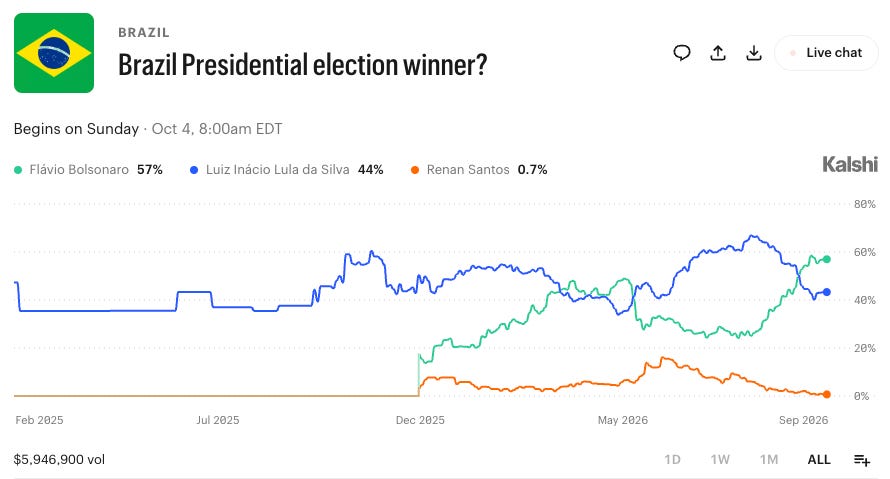
As of today, 29 September, prediction markets have Flavio around 57% likely to win.
Once trading volume is high enough, prediction markets appear to be well-calibrated on elections. Well-calibrated doesn’t mean they call the correct side of the coin flip every time. It means that if they say an election is 60-40, then the leading candidate wins six out of ten times and loses four out of ten times. And if they say an election is 95-5, then the leading candidate wins 19 out of 20 times, but still loses one out of every 20 times. Across thousands of (preferably non-correlated) elections, you can find that level of calibration.
That’s great for predicting across hundreds or thousands of elections or other events. For Brazil’s upcoming presidential election, there is just one shot.
Elections are quite different from predicting whether oil markets will go up or down today or whether Trump will say the words “fake news” during this morning’s speech1, where you get to try again tomorrow on the same market. For elections like this, the predictors don’t get to try again on that same market for several years. Meanwhile, the results of that single-day, near-coin-flip election will shape policy and human lives. More than economic or goofier markets repeated daily or weekly, the stakes are higher for which side of the 51-49 the coin lands during an election like this.
That’s one of the reasons we care far more about being on the right or wrong side of the 50% line than being well-calibrated.

In yesterday’s newsletter for paying subscribers, I had a few comments about recent Brazilian election polls. I also previewed a model I’m building with AI to run 20,000 Monte Carlo simulations per day of the election based on polls, prediction markets, and a few other factors. It has been fun to build, and I think it will be useful for future elections around the hemisphere. For this one, it’s more useful for confirming a dead heat than for predicting with certainty who will win.
The model currently shows Lula with a 54% chance of winning. After I poked it with a stick a few times to fix some variables that I think are a little off2, it came in at Lula with 51% chance of winning. That did not move after adding two more polls this morning.
However, these simulation models mostly depend on their assumptions. What is the error rate on polls? What does voter turnout look like? How do late-moving undecided voters choose? How do endorsements impact the second round? How often do Brazilian elections go to the second round? It’s easy to tweak the model in some very reasonable ways to get Flavio at 58% likely or Lula at 58% likely. This is a 50-50 election, and having the model pick which side of the coin I’m on risks giving false precision.

So why not just say it’s a 50-50 election? Doesn’t saying 55-45 or 51-49 give a false sense of precision?
Part of the problem is that analysis and punditry reward having a point of view more than they reward being well-calibrated. A long post about Brazil being a 50-50 election will cause people to glance over it and move on to the next thing. A well-argued piece about why it’s 55-45 in favor of one candidate and why Lula/Flavio have that edge will be read, debated, and attacked by trolls.
And at that point, it barely matters whether you say it’s 51-49 or 80-20. Many readers will only remember which side of the line you were on. As Phil Tetlock has shown, bad and bold public predictions get more airtime than careful and correct hedges. So ahead of the election, you might as well go all in. Lula is going to win this thing because Flavio is a terrible candidate. Flavio has the election in the bag thanks to Lula’s economic mismanagement and regional anti-incumbent trends. Pick a side!
The only thing worse is the credence given to analysts who never make a prediction ahead of time and then after the election will tell you all the reasons it was obvious that Lula or Flavio won. Hindsight bias is real. Sometimes an election really is close to 50-50. Or it’s 60-40, but the less likely candidate wins. It can be as simple as how the coin landed that particular day.

Even if they are not always “correct,” these highly calibrated markets still offer an advantage. Knowing whether the situation is close to 50-50, or 80-20 or 95-5 gives you an important signal for how much you should plan for the base scenario and how much you should plan for the outlier (the impact of each scenario being the other key variable).
I worry about how many companies and investors see prediction markets saying Flavio at 57% or some analyst’s model putting Lula at 51%, and over-prepare or put money down on the slightly more likely scenario while under-preparing for the other, even though the odds are very similar for a single event.
With a well-calibrated system, people using these prediction models to make decisions and investments should focus more on the difference between an 80% and 55% probability than on which side of the line the 55% prediction falls. An 80% prediction tells you to really prepare for one event as the base scenario and the other as the outlier. A 55% probability should have you preparing both sides essentially equally.
Yes, it’s obvious and you all know that in some mathematical way when you think about it. No, you probably don’t act that way. I don’t. We all want to guess the coin flip correctly, and we overreact to our prediction, even if we know it’s false precision or that for a high-impact one-off event, the calibration of perfect prediction won’t matter.

So what am I predicting today?
I’m >90% certain that the Brazilian presidential election is going to a second round.
I’m more than 80% certain that Tarcisio will win the Sao Paulo governor race but slightly under 50% that he pulls it off in the first round.
I’m around 70% certain that Lula will lead the first round of the election, though I’m still around 30% that Flavio may pull off the upset.
And I’m at 51% likely that Lula wins the election and will be inaugurated in January for his fourth and final term in office. Though I’ll likely update that prediction after we see the results on Sunday. Because updating predictions when you get new information is always a good idea.
Treat those predictions for what they are.
Thanks for reading.
something on which you can actually make a monetary prediction
in short, I feel relatively confident that the model’s odds of a first round win are too high. The model thinks there is a 12% chance of Lula winning in the first round, which it bases on historic polling errors. I think the base rate on recent Brazilian elections going to a second round should be more heavily weighted. So I manually intervened to lower the odds of a first round win, even though that violates some of my other mathematical assumptions about polling error.